
White HANDS
ON BLAK ART
GET YOUR WHITE HANDS OFF IT, MURDOCH
This is a record.
In 2023, as the country moved through one of the most significant national conversations in recent history - the Voice to Parliament referendum - a parallel narrative about Aboriginal art centres in the Anangu Pitjantjatjara Yankunytjatjara (APY) Lands was developed, then repeated, and ultimately thrashed across the media landscape.
THIS IS WHAT THEY SAID , WHAT'S TRUE AND WHAT'S NEXT
It didn't start quietly
The White Hands on Blak Art coverage did not arrive quietly.
It arrived with force and noise - ripping through the sector and into the APY Lands over Easter weekend 2023.
It landed like a king hit: aimed at an internationally celebrated art movement, and at the cultural and economic art centres that provide a safe, Aboriginal-led foundation for artists across the APY Lands.
Across that year, The Australian published a sustained series of stories questioning governance, integrity, and legitimacy within Aboriginal art centres. They targeted individual artists, their communities, and the art centres that sustain the sector.
The sheer volume of articles mattered – it gave the narrative force, visibility and the appearance of legitimacy.
Repetition creates weight.
And weight begins to feel like truth.
This site exists to examine that moment.

What was said...
Over dozens of articles, a consistent narrative was constructed:
That Aboriginal art centres were compromised.
That governance was flawed.
That artists were being misrepresented or controlled.
That “fake” Aboriginal art was being produced within the system.
These claims were repeated - across headlines, features, and commentary - until they began to read as established fact, during a year when Aboriginal voices were already under national scrutiny.
The timing was not coincidental.
Greg Bearup arrived on the APY Lands for the first time in November 2022 as part
of a ministerial press trip.
He spent one day there.
From that single visit, a narrative began.
In the months that followed, Bearup positioned himself as an authority on the region - its governance, its art centres
and its people.

THE CHOSEN
ONE
This is a dangerous posture far too familiar to Aboriginal people: the outsider with no experience, as the self-appointed protector of Aboriginal people and culture.
His reporting asserted systemic failure: financial mismanagement, fraud, cultural breakdown. The repetition of these claims across multiple articles, was amplified nationally and reinforced through sheer frequency rather than new evidence.
What Greg Bearup didn’t bother to learn is that Anangu have led sustained, complex work for decades - across land rights, governance, health, law, and cultural continuity.
There is a deeply established system of leadership with direct lines to some of the most experienced figures in the country.
The idea that issues within the Art Centres, so rank could go so unchecked - and require intervention from an external journalist with no prior experience in the region - is absurd.

The repetition was relentless.
The evidence was not.
Leaders such as Andrea Mason OAM, CEO of the NPY Women’s Council, Sarah Brown OAM, a senior figure in Aboriginal health and governance and Steven Marshall former premier of South Australia represent just part of that network.
There are multiple Anangu leaders with national honours. They sit on boards, lead organisations, and shape policy. They work closely with lawyers, anthropologists, senior public servants and political figures at the highest levels of government.
These leaders, those with the deepest knowledge, longest experience and clear authority are the individuals that Bearup excluded.
Bearup’s reporting followed a narrow line. He spoke to those who confirmed the narrative he was already constructing. Many of his key sources, even key Anangu sources, have never spent time inside APY Art Centre Collective studios, and are unknown to staff.
He did not engage with many of the most experienced art centre staff on the ground - with 25+ years of experience among them, including from some of the most successful centres in the country, such as Iwantja Arts and Mimili Maku Arts. He did not speak to Vincent Namatjira, Archibald Prize winner and Order of Australia medal recipient, who lives and works in the APY Lands. Nor did he engage with Zaachariaha Fielding, a nationally recognised musician or his brother Zibeon, a young leader and marathon runner, mentored by Robert DeCastella through the Indigenous Marathon Foundation, both from Mimili on the APY Lands or to their father, high profile local hero Robert Fielding, a leader of a new innovative men’s program in Mimili.
Instead, the perspective leaned towards those equally inexperienced, those harbouring jealousies over APY Art Centre Collective success and competitors who he called industry experts, all private dealers or supporters of the private dealers' model.
It was a selective narrative - built quickly, repeated often, and presented for the benefit of Bearup’s own profile & legacy. It reflected The Australian’s anti-voice to parliament agenda and that of the non-indigenous operators in the industry that have been making profits that belong in Aboriginal pockets for decades.
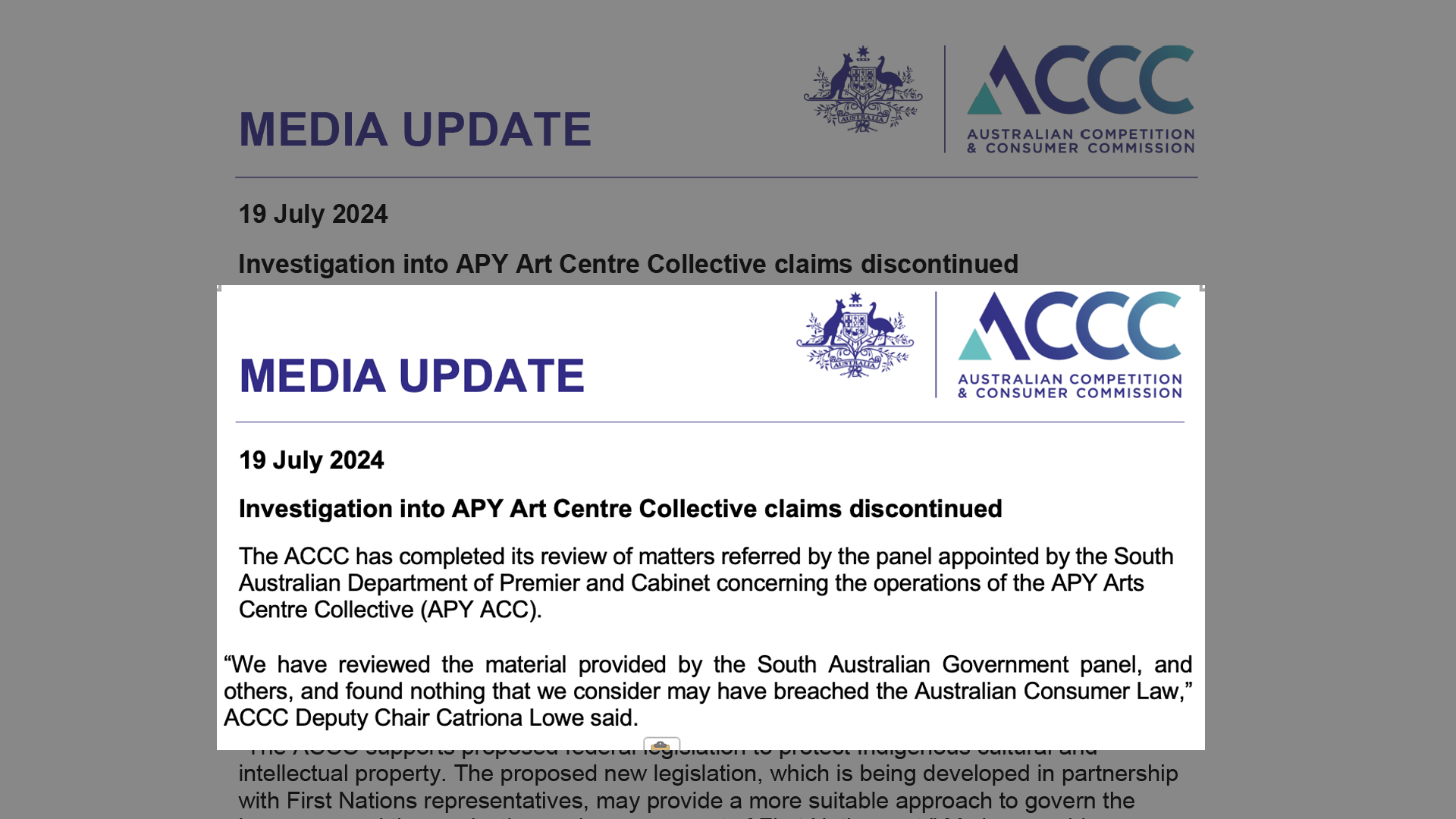
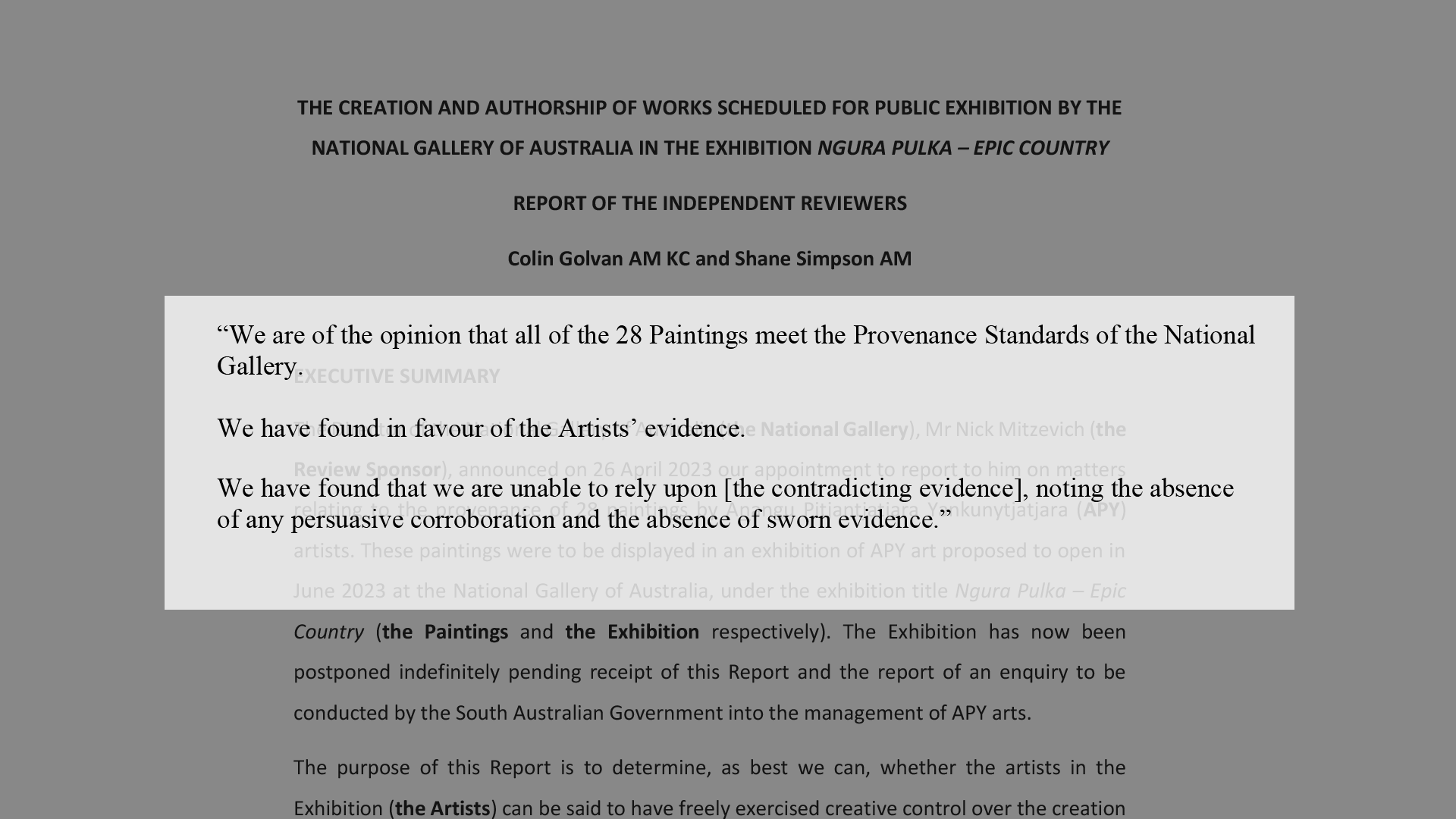
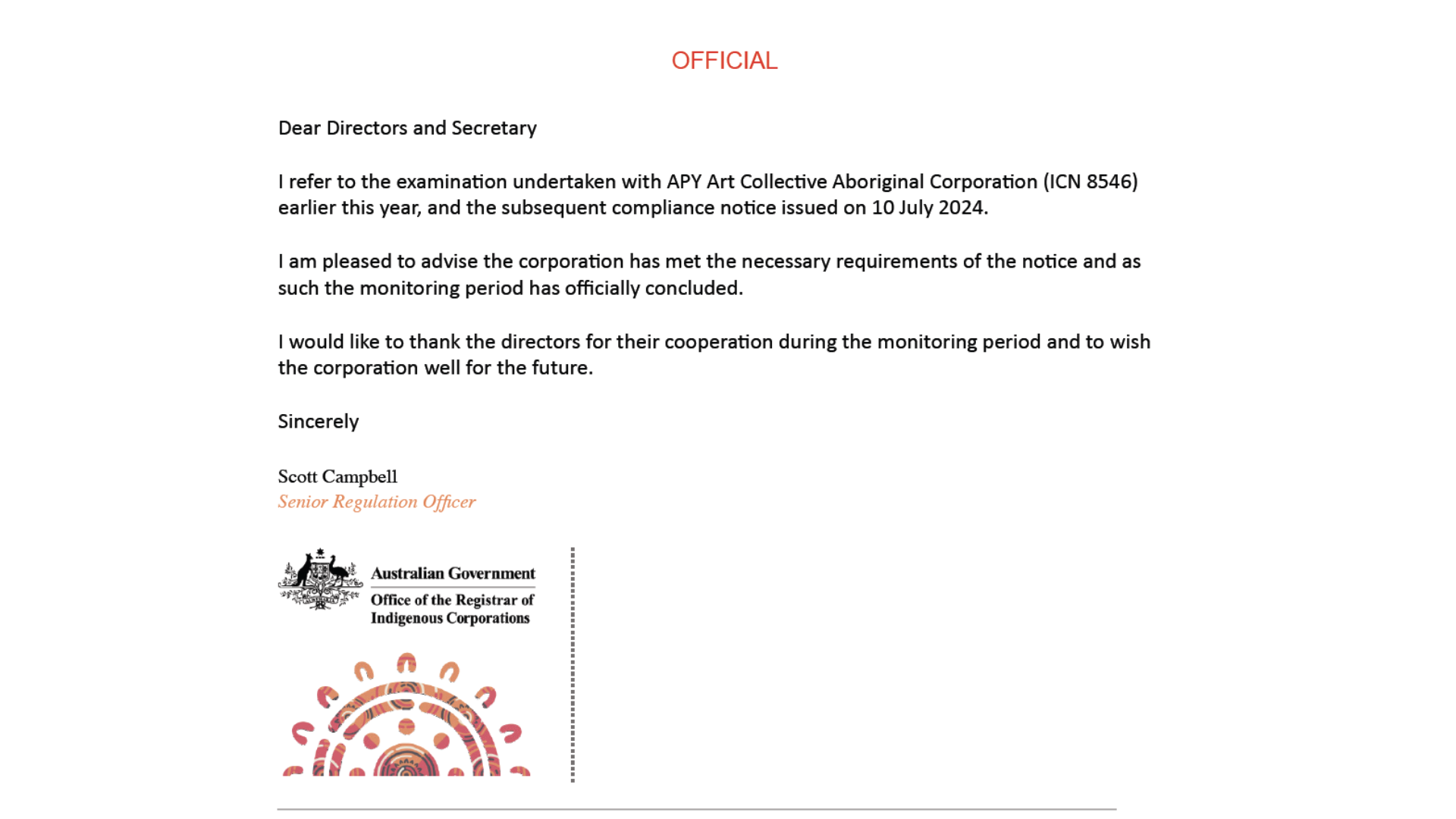
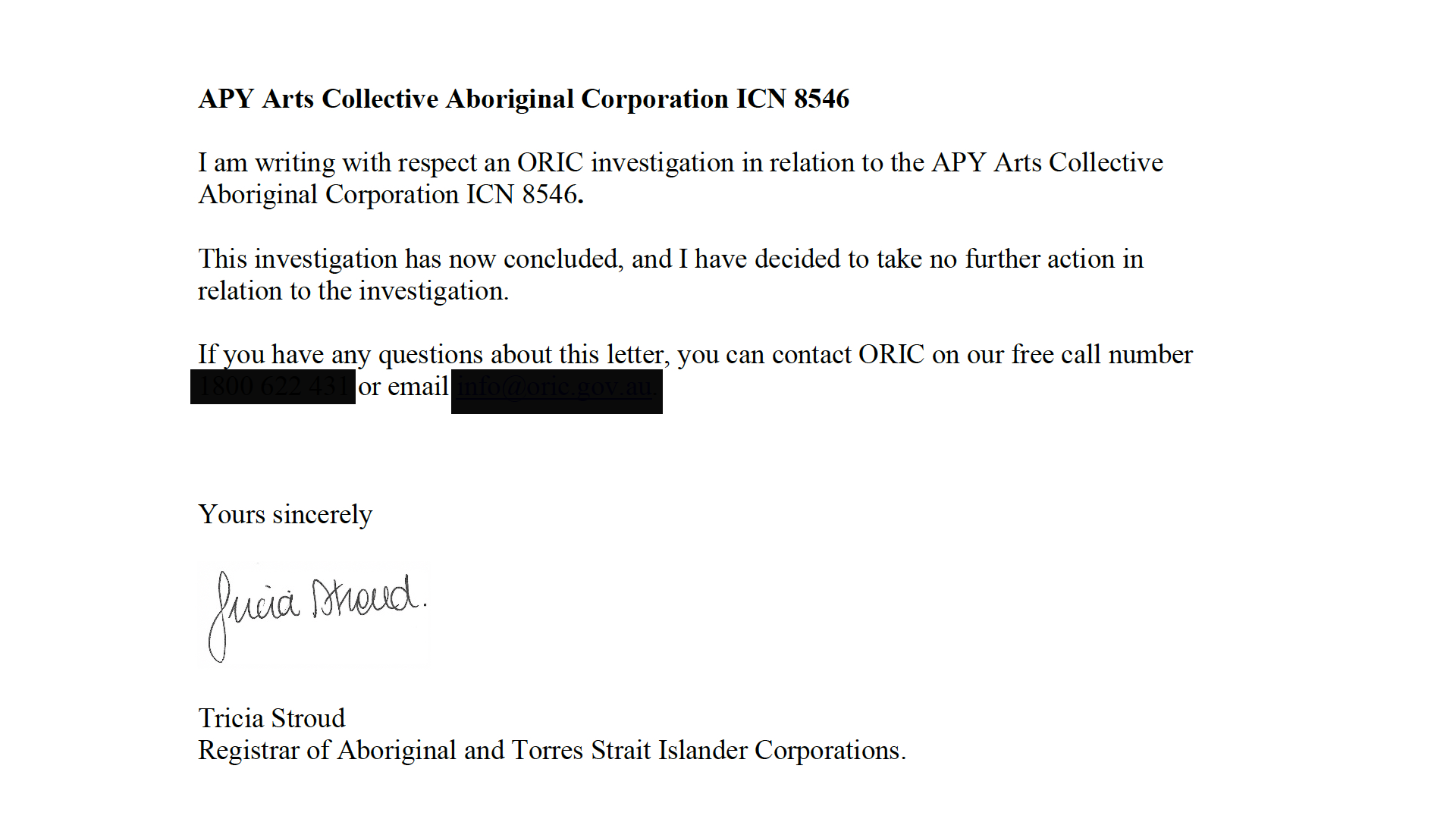
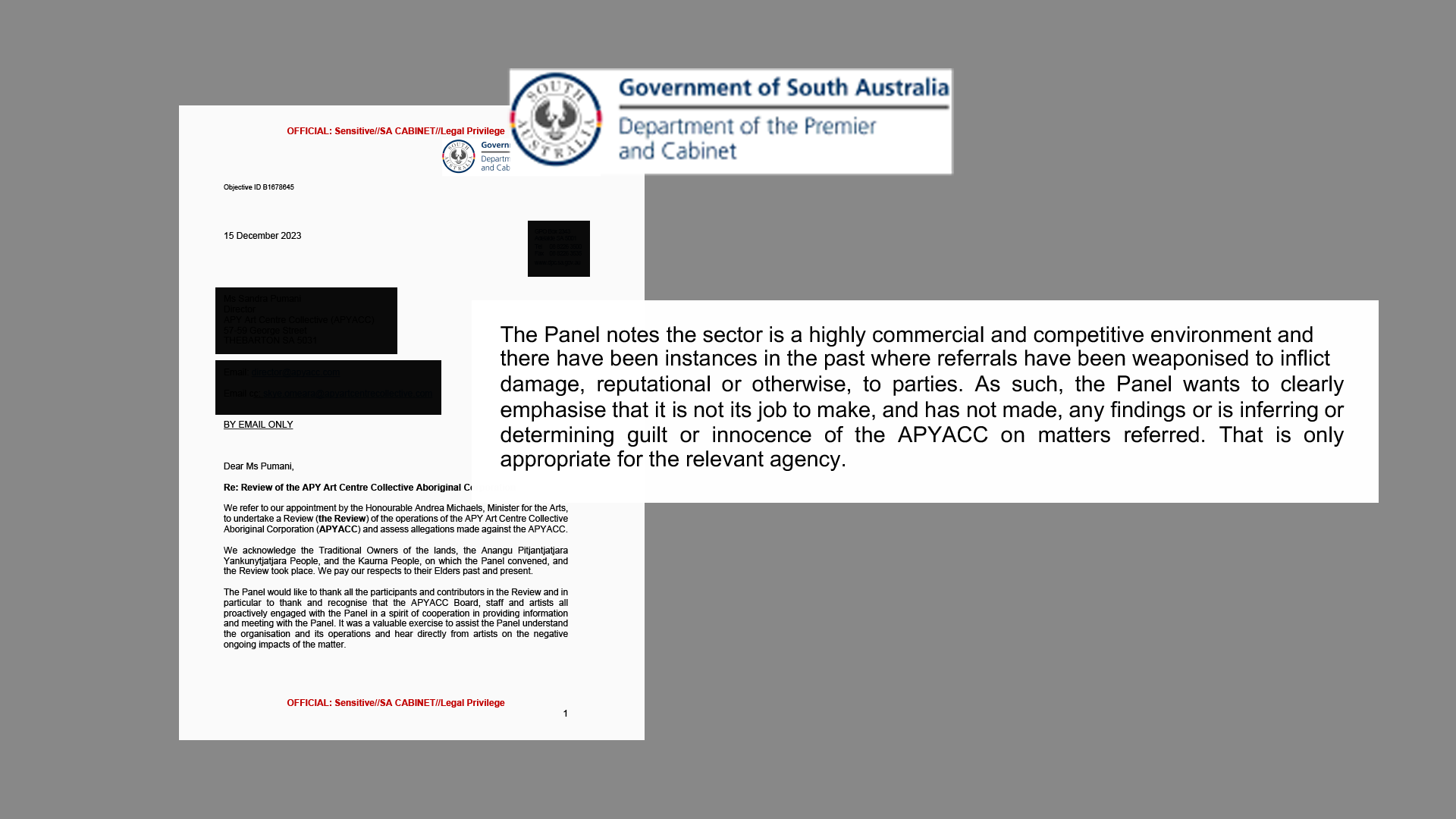
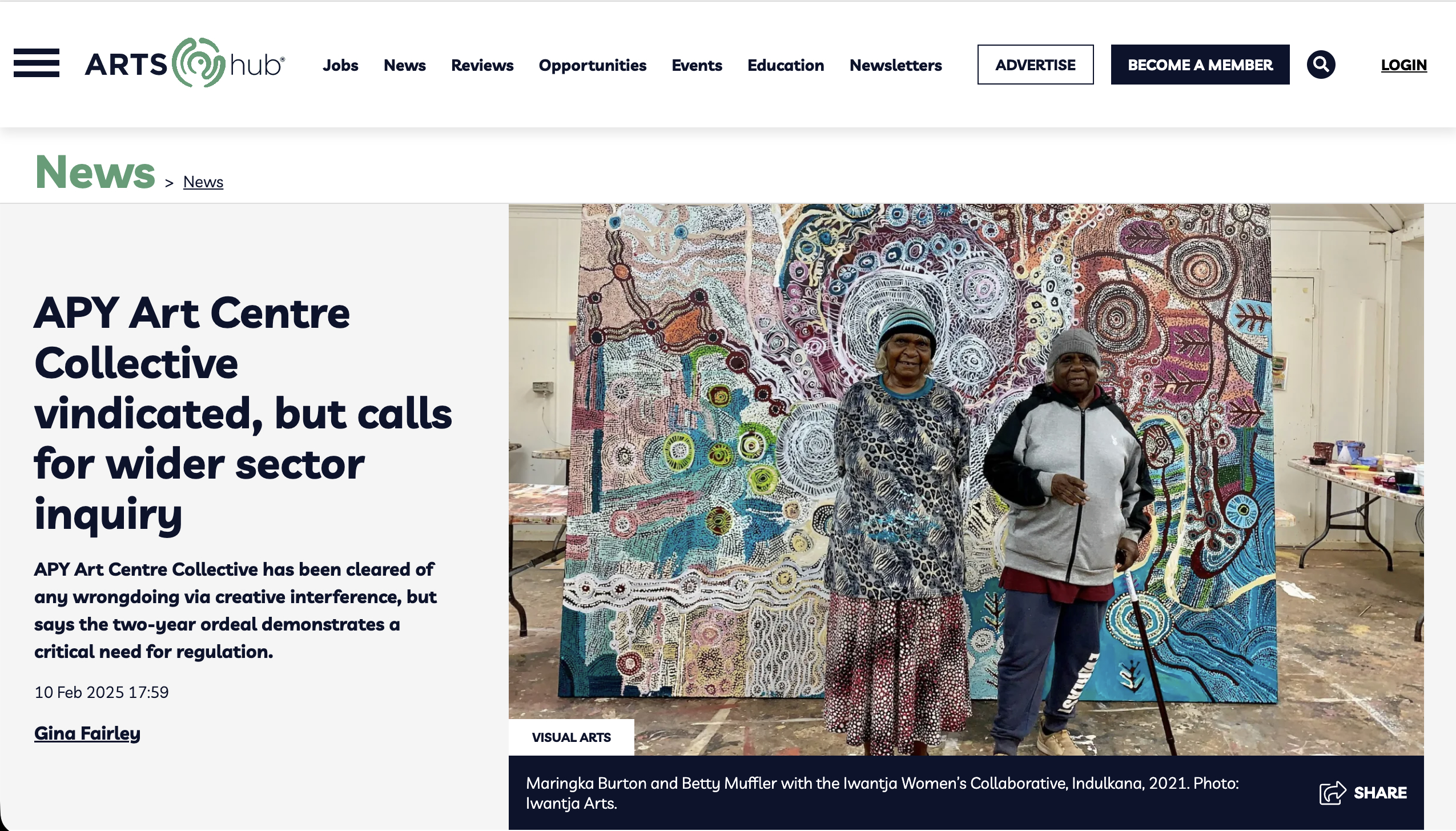
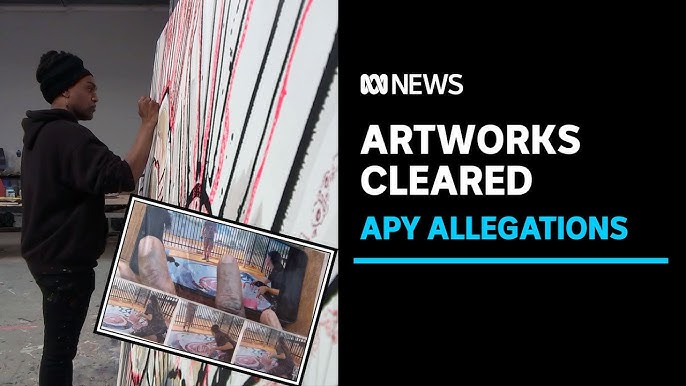
Over the two years that followed, four separate reviews examined the claims. Not one substantiated the central allegations.
The repetition was relentless. The evidence was not.
CLAIM
REALITY
White staff were painting substantial parts of Indigenous artworks.
Investigated. Not upheld.
This was happening regularly across art centres.
Investigated. Not upheld.
The problems extended across multiple areas of the organisation.
Investigated. Not upheld.
There was wrongdoing in every area of the organisation.
Investigated. Not upheld.
These practices were being concealed and needed to be uncovered.
Investigated. Not upheld.
Was it, Greg?
Intervention was required to expose what was happening inside the art centres.
Bearup's claims were unsubstantiated and deeply damaging
4 REVIEWS
2 YEARS
NOT A SINGLE ADVERSE FINDING

THE EDITOR
Michelle Gunn is regarded as a senior figure in Australian media, an editor with significant influence over what is published - and what is not. In her role, she oversaw the development and progression of the White Hands on Blak Art coverage, including the work of multiple journalists contributing to that narrative, including Greg Bearup and Christopher Allen.
Nyunmiti Burton is also a leader.
An accomplished artist, Nyunmiti has held key roles across her community: in remote education, as a Director of the NPY Women’s Council, and as a member of the APY Executive Committee. Her leadership is grounded in lived experience, cultural authority and long-standing service.
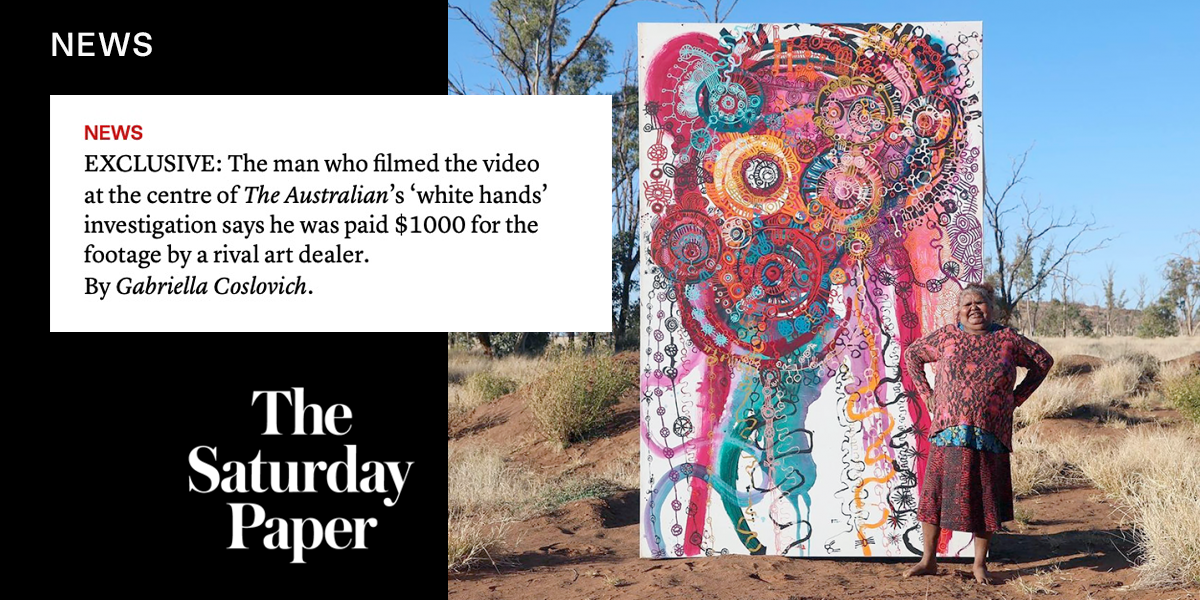
In late 2022, Nyunmiti Burton was brought into a competing art studio, Iwiri Arts, by Sam Osbourne, a non-Indigenous manager at Iwiri Arts, who was assisting Mr Bearup in his "White Hands" work. Mr Bearup was waiting for Nyunmiti at the Iwiri premises at Tauondi College in Port Adelaide. At the time, Nyunmiti was in dispute with her peers and staff at the APY Art Centre Collective and was encouraged to share her frustrations. She was filmed by Mr Bearup that day.
Nyunmiti regards this as the most significant error of judgement in her adult life.
Within a week, Nyunmiti recognised and regretted her mistake and wrote to Mr Bearup withdrawing her statements.
These requests were not acted on.
In 2023, Nyunmiti Burton wrote to Michelle Gunn on three separate occasions. She asked that the video be removed. She followed these requests with recorded video messages—clear, direct, and personal.
The requests were not acted on.

Michelle Gunn and Nyunmiti Burton are of a similar age.
But they operate in entirely different worlds - one with the power to publish, the other carrying significantly less power.
Nyunmiti’s world is not shaped by headlines, but by responsibility. It is a world of language, law, and cultural obligation.
Of raising families across generations, of teaching, of governing, of holding community together in places where systems are thin and expectations are high. It is a world where reputation is not abstract - it can determine access to independence, to income, to future.
It is also a world shaped by measurable pressure
First Nations women are imprisoned at over 21 times the rate of non-Indigenous women
(Australian Human Rights Commission, 2023)
First Nations adults overall are incarcerated at around 18 times the rate of non-Indigenous Australians
(Australian Institute of Health and Welfare, 2023)
In 2023, 66–82% of assaults against First Nations people were family violence–related, with most victims women (Australian Institute of Health and Welfare, 2023)
Two in three people who experienced physical harm reported the perpetrator was a family member
(Australian Institute of Health and Welfare, 2023)
Across crisis systems, the pattern continues:
First Nations people make up 28% of all homelessness service users, and of those, 40% are escaping family violence - most of them women (Australian Institute of Health and Welfare, 2023)
Children carry this weight as well.
First Nations children account for 32% of all children in child protection systems, and over half of those in out-of-home care (Australian Institute of Health and Welfare, 2023)
These are not abstract conditions.
They are the conditions of Nyunmiti’s world.
Michelle moved on to another story.
Nyunmiti’s life continues in hers.

A MATTER
OF TASTE
Dr. Christopher Allen is a prominent Australian art critic, historian, and author who has served as the national art critic for The Australian since 2008. He is known for his traditional, scholarly approach to art criticism and his critique of contemporary identity politics in art.
"Even before these revelations, it should have been clear how bad much of the APY work was – the enormous, hyperactive, spineless doodles that have consumed exhibitions like the Wynne Prize for landscape in recent years, and which in many cases look uncomfortably like pastiches of John Olsen’s abstraction."
CHRISTOPHER ALLEN ON APY ART
Christopher Allen, Christopher A.,
Does not like Aboriginal art - no way.
Not in museums, not for prizes,
Not in forms or any sizes.
Not in summer, not in spring,
Not in any painted thing.
From The Sydney Grammar halls so trimmed and neat,
He learned to protect the space of the “white elite.”
"I do not like it,” this spineless squiggle
Its outside my world, a strange black riddle.
“I do not like it,” firm, composed—
He only likes what he already knows.
He likes it safe, he likes it known,
He likes the world that looks like his own.
Rich white men, a tidy frame—
How strange, it all looks just the same.
But taste, dear Chris, is not innate—
It’s schooled, selected… cultivated.
And what you scorn, dismiss, or part—
Says more of you than of the art.

"these acrylic paintings are almost by definition the work of untrained amateurs"
HOW THE
STORY
SPREAD

What began as a series of articles quickly became something larger.
Other commentators followed.
Critics amplified.
Cartoons reinforced the tone.
Competitors and opportunists piled on.
Well-intentioned but naïve voices were drawn in - their concern redirected and, at times, weaponised against artists.

Opinion hardened.
A narrative took hold:
Through repetition, alignment, and reach, the story gathered momentum - shifting from reporting into assumption, and from assumption into something that carried the weight of fact.


The volume, visibility and at times hysterical tone of the coverage sent a shock through the sector.
An industry known for courageous and outspoken leadership fell, for a time, into silence.
LIKE FATHER, LIKE SON
The cartoons of Bill Leak (1956–2017) and his son Johannes Leak at The Australian newspaper have been widely criticized for perpetuating racist stereotypes and dehumanizing Indigenous Australians and other minority groups.
Below are two racist cartoons from The Australian drawn by Bill (left) and then later echoed by Johannes (right).


A vacuum of leadership created space for opportunists and bad actors to step forward.
THE PILE ON

Mel
George

John McDonald

Luke
Scholls

Adrian
Newstead

Jeremy
Eccles

Richard
England

Sam
Osbourne

Chris
Simon

Rowena
Withers
Some arrived with their own agendas.
Others - well-intentioned but naïve - were drawn in, then used to amplify a narrative that ultimately worked against the very artists they sought to support.
WHAT THE EVIDENCE SHOWS
Across multiple independent reviews - spanning years, involving significant public investment, and conducted under scrutiny - no findings of systemic wrongdoing were made. Not one of the central allegations was upheld. These inquiries were led by some of the most respected experts in the country.
No collapse of governance.
No confirmation of the claims that had been repeated.
The gap between what was written and what was found matters.
Because it reveals something more fundamental:
The narrative was asserted as fact, without evidence to sustain it.
The story repeated until it carried authority—was then tested, and not upheld.
This was not a difference of opinion, but a clear divide between
what was claimed and what could be proven.
4
REVIEWS
2
YEARS
0
ALLEGATIONS
UPHELD


"WHEN ARTISTS LIKE US RUN OUR OWN BUSINESS, THE MONEY GOES BACK TO OUR FAMILIES AND COMMUNITY.
EVERYONE
IN OUR COMMUNITY SHARES IN THE SUCCESS.
OUR YOUNGER ARTISTS ARE COMING UP, WHICH WILL HELP ANANGU KEEP OUR CULTURE STRONG FOR THE FUTURE.
OUR ART, OUR BUSINESS."
Frank Young,
Tjala Arts

THE ARTISTS
INVOLVED


Nyunmiti Burton
Paul Andy
Status: PRACTICING ARTIST AT APY
Status: PRACTICING ARTIST AT APY
After speaking with Greg Bearup, Nyunmiti almost immediately went back to the APY Art Centre Collective studio in Adelaide. Highlights since 2023 include her work being featured on an Australia Post stamp and her inclusion in the 2025 Wynne Prize. She is planning her first exhibition in New York in late 2026. Nyunmiti continues to work at the APY Art Centre Collective studio in Adelaide and contributes to collaborative projects.
Paul Andy also returned to the APY Art Centre Collective studio in Adelaide. He enjoys a senior role within the ceramics studio. His paintings and ceramics are regularly included in the APYACC exhibition program. Paul Andy welcomed a new grandson in October 2025.
Note: In 2023 The NGA review panel attempted to interview Paul Andy and was told by Sam Osbourne of Iwiri Arts (the man responsible for taking Greg Bearup around Adelaide to meet with artists, and often translating for them) that he couldn’t be interviewed for cultural reasons. Greg Bearup then reported that the omission of Mr Andy’s testimony to the NGA review made the report one-sided and unreliable.


Makinti Minutjukur
Derrik Lynch
Status: ARTIST ERNABELLA ARTS
Status: DANCER, ACTOR & PERFORMER
Makinti Minutjukur visited the APY Art Centre Collective studio for the first time during the Christmas period in 2025, she had not previously worked at or engaged with the APY Art Centre Collective, and had not produced work with the Collective.
Derrik Lynch worked at the APY Art Centre Collective studio in 2020 on several occasions, producing two artworks during this period. His engagement with the studio was very brief.
However senior artists are proud of his recent achievement in the theatre space.

Tjungkara Ken
Status: PRACTICING ARTIST AT TJALA
ARTS, REGULARLY VISITS APYACC
Tjungkara Ken was interviewed by Greg Bearup in the studio of private art dealer Chris Simon, with translation provided by Sam Osborne from Iwiri Arts.
She continues to work with Tjala Arts and the APY Art Centre Collective, where her career and artistic practice continue to develop. She was recently nominated to the Board of Tjala Arts and is currently showing at Cassandra Bird Gallery in Sydney.

TO NOTE:
During Greg Bearup’s reporting in late 2022, a number of artist interviews were facilitated by Sam Osbourne, who is also coordinator of the Pitjantjatjara Yankunytjatjara Summer School.
The Summer School period coincided with these interviews.
So at the time of interview, some of these artists were being paid through the Summer School program.
What wasn't discussed...
There are two distinct models in the
Aboriginal art sector.
They are not new.
They are not interchangeable.
"PRIVATE DEALERS"
ART CENTRES
-
Aboriginal-owned
-
Aboriginal-governed
-
Artist-owned social enterprise
-
Not-for-profit
-
accessible to all individual in remote communities including artists with disabilities and emerging artists
-
Widely recognised as the ethical model because of the financial and governance transparency required under ORIC including exposure to independent annual audit, published on the ORIC website
-
Income is generated in remote indigenous communities and is spent in remote Aboriginal communities
-
Only independent income in many remote Aboriginal communities
PRIVATE DEALERS
Privately owned, for-profit operators
Overwhelmingly non-Indigenous
No requirements for transparency and accountability under this business model
Income is generated in met spaces under commission structures determined by the non-indigenous business owner
This part of the market has been the subject of hundreds of complaints over decades.
It was a key driver of the 2008 Senate Inquiry into the Indigenous art sector.
Concerns have consistently included:
-
The poaching of high-profile artists from remote indigenous art centres because of their high price point
-
Exclusion of emerging artists, artists with disabilities because of low price point
-
Underpayment of artists
-
Coercive practices
-
Poor documentation
-
Profits leaving community

Jeremy
Eccles
Adam
Knight

Ken
McGreggor

John
Ioannou (Yani)

Chris
Simon
A known divide
This distinction is well understood across government, industry bodies, and the sector itself.
For decades, Aboriginal art centres have raised concerns about private dealer conduct.
What was missing
In Greg Bearup's extensive national reporting, this context was largely absent. There was little examination of:
– The two production models
– Where accountability sits
– The long history of complaints tied to private dealers
Instead, scrutiny focused on Aboriginal-owned art centres.
Not just observers
Some private dealers did not simply benefit from this coverage.
They participated in it.
This includes:
-
Interviews conducted with artists in private studio settings
-
Interviews with vulnerable artists and artists living with addiction issues
-
Material generated and circulated through dealer networks
-
Content aligned with and amplifying the campaign narrative
For example:
Tjungkara Ken was interviewed while intoxicated in Chris Simon’s studio in Alice Springs
A video of Tingila Young, later used within the “White Hands on Blak Art” campaign, was funded through Chris Simon.

A reversal
For decades, art centres have raised concerns about private dealers.
In this instance, similar allegations were redirected at the art centres -
without acknowledging that history.
Why it matters
Confusing these models:
– Obscures where risk has historically existed
– Misrepresents the ethical framework of art centres
– Shifts scrutiny away from non-Indigenous, for-profit operators
And in doing so:
It places Aboriginal-owned organisations under suspicion while leaving the least regulated part of the market largely unexamined.

Aboriginal art centres are not abstract institutions
They are:
- Aboriginal-led organisations
- Economic engines in remote communities—within the APY Lands,
a rare source of non-government income
- Cultural authorities grounded in continuity, not commentary
- Instruments through which elders are building futures beyond poverty for the next generation
What is said about them has consequences.
- For artists
- For communities
- For how Aboriginal ambition and success is understood - or undermined - at a national level
In 2023, those consequences played out in real time.


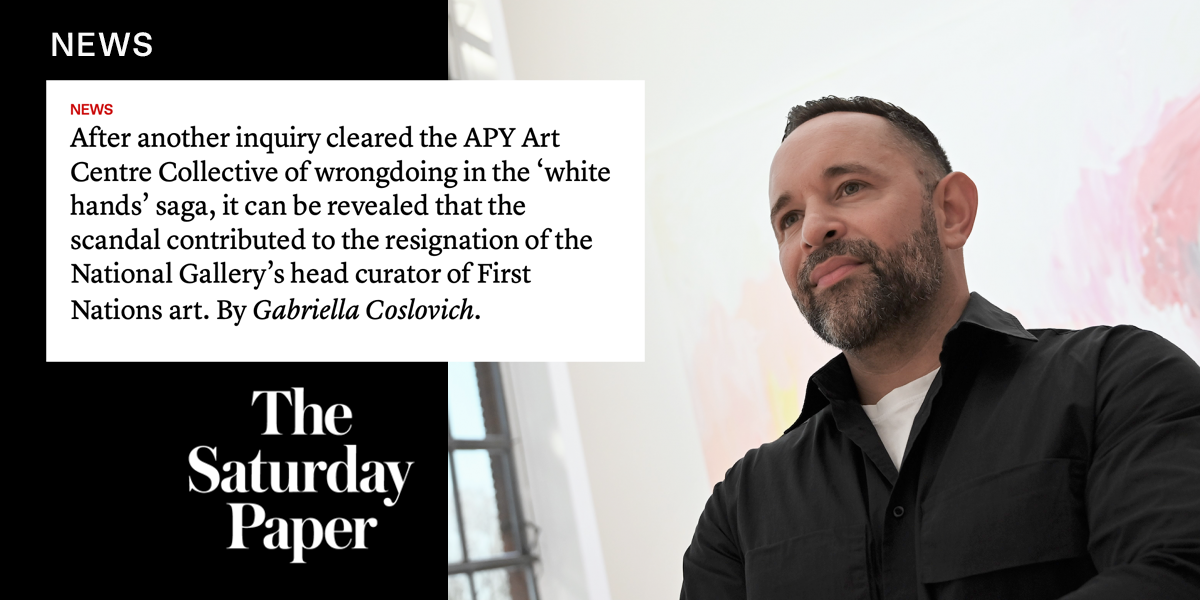
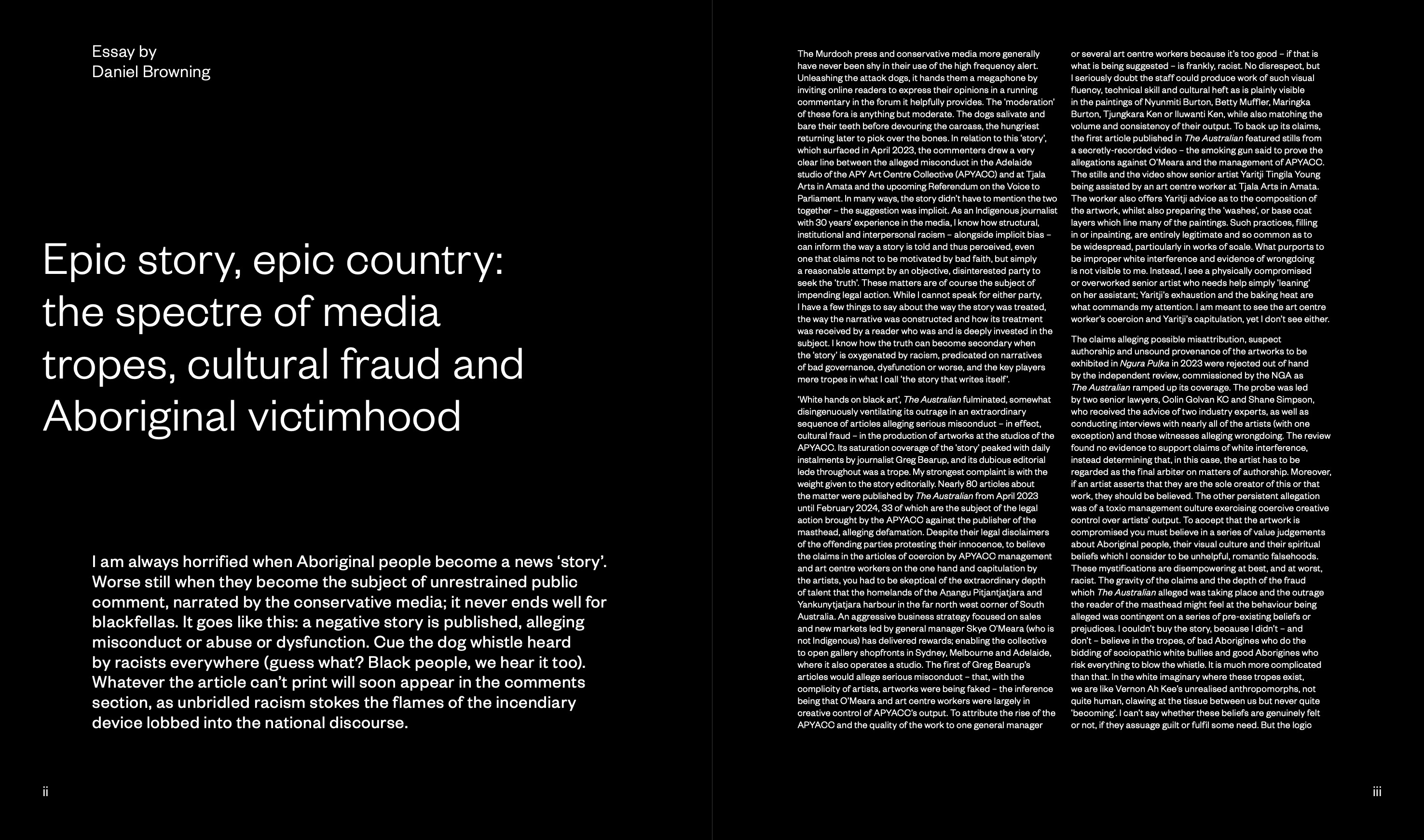

This Moment
Now, as the National Gallery of Australia prepares to present
Ngura Pulka - a landmark exhibition of APY art on a national stage -
the contrast is clear.
On one hand:
2 years of sustained media attack and public scrutiny.
On the other:
A body of work of undeniable scale, significance, and continuity.
In November 2025, the APY Art Centre Collective commenced defamation proceedings in the Supreme Court of South Australia against Nationwide News Pty Ltd and journalist Greg Bearup.
The proceedings remain before the Court at the time of publication.